
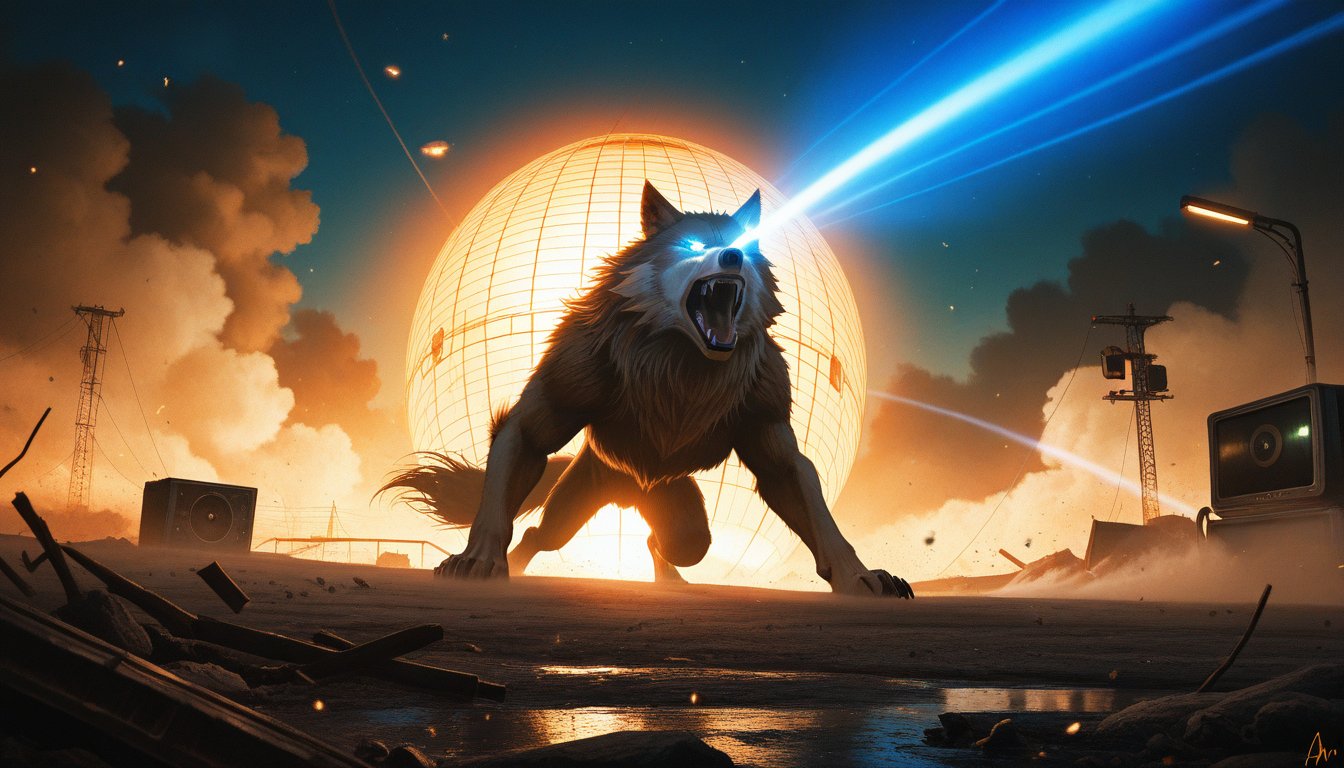
The transmission runs four minutes, forty-one seconds, and nothing in it wastes time. A homestead on one of the drift-settlements past the Coalition’s thin border. A father, unnamed until the credits, standing in a doorway between his children and something the local folklore calls a Half-Turn — not wolf, not man, the frontier’s answer to what happens when a body stops deciding which shape it wants.
‘狼に抗え’ (‘Resist the Wolf’) arrived on the independent feeds last week with no fanfare, credited to Tenth Legion Transmissions and a director, Mikhal Drobeg, whose service record with the Fleet’s peacekeeping corps is public and, I suspect, load-bearing. You feel it in the fight. Not in the technical sense — though the technical sense is handled better than most frontier horror manages on a fabrication-shop budget — but in the grammar of the violence itself. This isn’t a man performing combat. This is a man who has spent actual years learning that hesitation gets people killed, pouring that knowledge into four minutes of myth.
What interests me isn’t whether the father wins. Of course he wins; the genre demands it, and spectacle alone would make that the whole review. What interests me is what winning requires of him. The Half-Turn isn’t dispatched with a clean shot or a clever trap. It’s beaten the way an animal is beaten — with his hands, with his weight, with a willingness to become, for the duration of the fight, something uncomfortably close to the thing he’s fighting. The short lingers on this. It wants you to notice that the line between protector and monster, in the moment protection actually becomes necessary, is thinner than the lullabies tell children it is.
This is where the piece earns its four minutes. Frontier settlements have produced a whole minor genre of wolf-myth lately — understandable, given how many drift-colonies sit one bad harvest from needing to defend themselves with whatever’s on hand. Most of those stories let the monster carry all the violence, so the human stays innocent. ‘Resist the Wolf’ refuses that mercy. The father’s children watch him become, briefly, something they’ll remember being afraid of. That’s the cost nobody puts on the recruitment transmissions, and it’s the cost this one insists on showing.
I don’t know what Drobeg believes about the peacekeeping operations he served in — the short isn’t interested in confessing that directly, and I wouldn’t ask a monster movie to carry an op-ed. But I know what the film believes about fatherhood: that it is not an identity you get to keep clean. That loving something enough to defend it means agreeing, in advance, to become briefly unlovable in its defense. The wolf isn’t the villain here so much as the mirror. Four minutes, and it still hasn’t let me look away.