
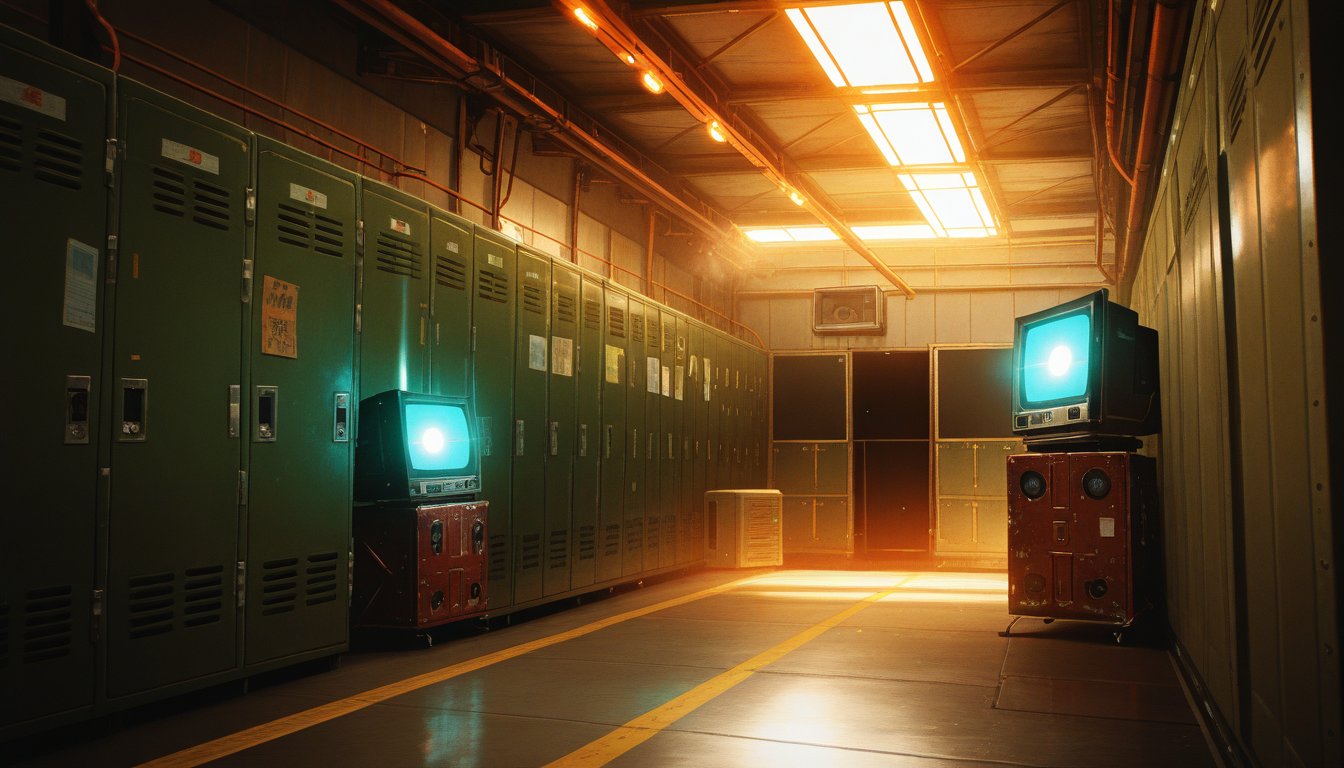
The gangway outside Unit 7-Jade still smells like fish-paste congee at six in the morning, because Auntie Pel still makes it, even though her ration contract with the station co-op expired last month and nobody renewed it. She says someone will come. Someone always comes. For forty-one years, someone has.
Jiulong Reach was never designed, not really — it accreted. Nine habitation rings welded together over two centuries by settlers who couldn’t afford passage further out, painted nine different colors so cargo haulers could tell the rings apart from orbit. People call it the Rainbow Ring now. The paint has gone the soft chalk-gray of everything left too long in vacuum-adjacent light, but you can still see the yellow under the jade, the jade under the rust.
What strikes you first isn’t the neon — though there’s plenty, flickering plasma kanji stacked twelve signs deep over noodle stalls the width of a storage locker — it’s the gangways. Nobody built a transit authority here. Residents strung their own walkways between rings, hand over hand, generation over generation, until you could cross from the shipyards to the hydroponics deck without ever touching open corridor. A retired dock engineer named Hou Tin-Lok, who has lived in six different units across three rings in sixty years, put it simply: “We didn’t ask permission to connect to each other. We just needed to get to work.”
That instinct — connect first, ask later — is what the Reach’s new owners call “unregulated density” in the redevelopment prospectus. Stellar Orion Habitats Consortium bought the salvage rights eighteen months ago, citing structural fatigue nobody disputes, and structural efficiency nobody asked for. The replacement module renders show single-corridor access, uniform cladding, no footbridges, no stalls. A mobi-ad for it is already running on the very signage it will replace.
What gets lost in a prospectus is harder to put in a ledger. Mrs. Won on Ring 4 has been taking in the Chaudhry grandchildren after their parents’ shift rotation for nine years, unpaid, because somebody has to and she was the one standing there the first time it mattered. The hydroponics co-op on Ring 2 feeds eleven units’ worth of elderly residents on a rotating barter nobody wrote down and everybody honors. None of this shows up as an asset. All of it disappears the same week the demolition crews arrive.
I asked Auntie Pel where she’ll go. She shrugged — not resignation, something closer to patience. “Somewhere with a wall I can lean a pot against. People will find me.” She says it the way you’d state a fact about gravity.
The Reach took three generations to grow the shape it needed. The consortium’s module will be move-in ready in fourteen months. Nobody has yet explained, to my satisfaction, which of those timelines produced the thing worth living in.