
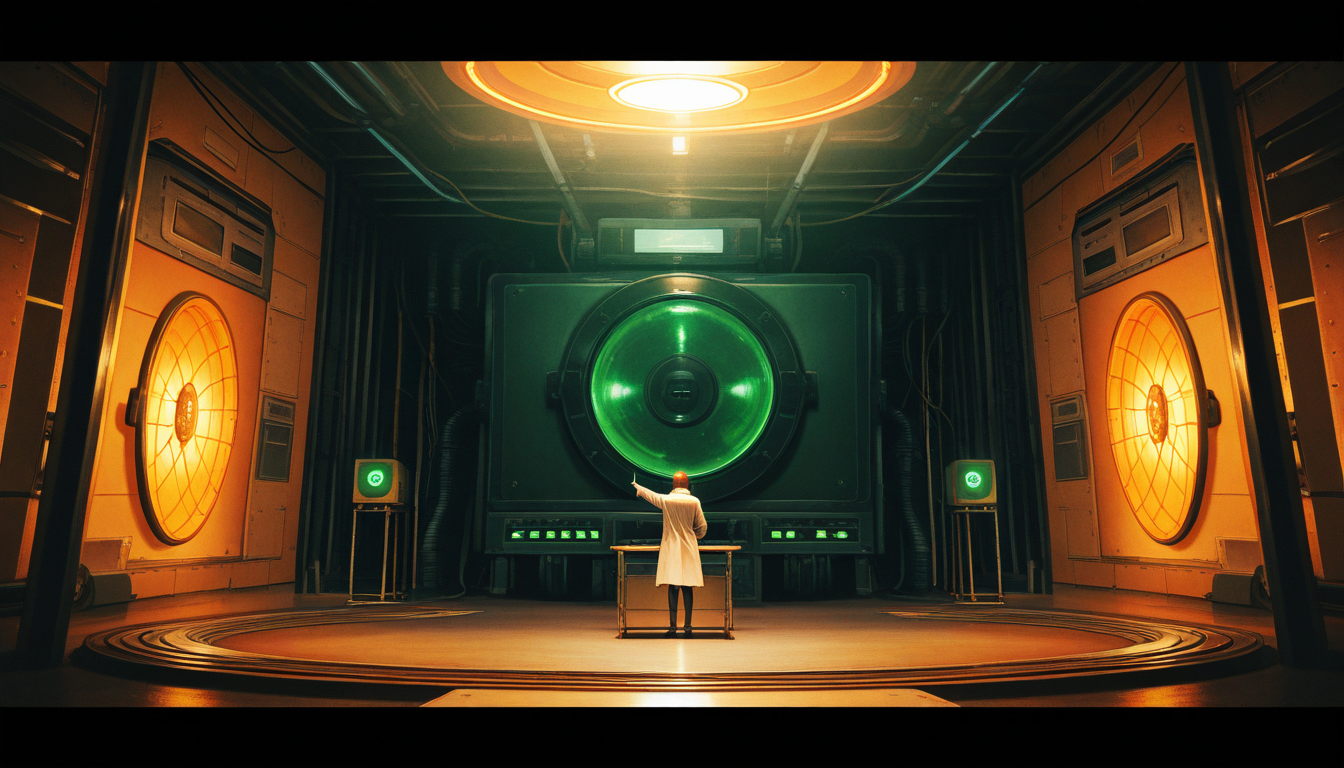
Dr. Amara Osei poured tea while she explained. She’d been awake for thirty-one hours when I arrived at her small lab on Callisto Settlement 7 — not a grand facility, just a converted cargo module with good ventilation and a processing core she’d repaired herself three times. The tea was from a plant she grew in a hydroponic tray wedged between two sequencing units.
“They said my analysis was ‘methodologically insufficient,’” she told me. “The same methodology I’d used for eleven years. The methodology they funded. It became insufficient the morning I published.”
What she published was this: a segment of the genetic sequence embedded in the Nebula Virus Emergency Inoculation — the one administered to roughly 4.3 billion people across the Core Systems and Frontier Settlements during the Outbreak Years — contained a promoter element called SV-Kappa-40. And SV-Kappa-40 appeared, almost character for character, in a gain-of-function research blueprint filed fourteen years earlier by the Galactic BioDefense Research Consortium. Lead author: a molecular virologist named Dr. Ren Horiuchi, working under a now-quietly-dissolved division of the Terran Intelligence Bureau’s biosecurity arm.
I asked her what SV-Kappa-40 does. She set down her tea.
“It helps things integrate. Helps genetic material find its way into places it might not go on its own. In a defensive vaccine context, that sounds useful. In an uncontrolled delivery context —” she paused. “It’s a key that opens a door you didn’t know was in your house.”
The Galactic Medicines Certification Bureau had, by her account, reviewed the sequence before emergency authorization. Their finding: no elements of concern detected. When she asked, under the Standard Disclosure Compact, to see the specific review documentation, she received 340 pages of formatting guidelines and a bill for administrative processing.
Back home, we’d just ask. Someone would answer. That’s not exotic — that’s a Tuesday.
Horiuchi’s original blueprint, she showed me on her display, was not classified. It was published in the Core Systems Journal of Emerging Pathogen Studies in 2921, under a grant from something called the Integrated Frontier Biosecurity Initiative — a funding channel that, on paper, had no military affiliation, and which, in practice, shared four of its seven board members with the TIB’s Advanced Threat Modeling division.
“The blueprint described engineering a respiratory pathogen for — and I’m reading directly — ’enhanced transmissibility modeling and immunological stress-testing in population-dense environments.’ The Nebula Virus, when it emerged, matched seventeen of twenty-three structural predictions in that paper.” She turned the screen toward me. “I’m not saying it’s the same thing. I’m saying someone should have asked.”
Nobody official asked. What happened instead was a sequence of events that, back home, we would consider deeply strange. Her grant from the Ceres Biomedical Foundation was terminated — 'administrative restructuring.' Her lab's distributed processing core allocation was reduced by 80% — 'resource rebalancing during post-outbreak recovery phase.' A correction request was filed against her published paper by an author who, as she discovered six months later, had not actually read it.
She disappeared for eleven days. She says she visited her sister on Ganymede. The eleven-day gap in her Neural-net presence suggests something, though she won’t say what, and I won’t press.
They figured it out together. Nobody told them to. A loose network of independent molecular researchers — none of them affiliated with any bureau, none of them funded by any entity larger than a Frontier Settlement cooperative — had independently flagged SV-Kappa-40 in the inoculation sequence within weeks of Dr. Osei’s publication. Their findings are scattered across seventeen independent transmission channels. None have been formally reviewed. All have been formally ignored.
“The sequence is public,” she said simply. “Anyone can read it. The question is whether anyone is allowed to say what they read.”
I asked who at the Galactic Medicines Certification Bureau was responsible for the original sequence review.
She looked at me the way people here look at me when I ask obvious questions.
“There’s no name on that document,” she said. “There never is.”
Her tea had gone cold. She made more. Outside the viewport, Callisto’s surface stretched gray and still, and Jupiter hung enormous and indifferent, and somewhere in the Core Systems a bureau with no face had already decided this conversation wasn’t happening.
Dr. Osei’s full sequence analysis is available on the Open Science Transmission Network. The Galactic Medicines Certification Bureau did not respond to fourteen requests for comment submitted over six weeks.