
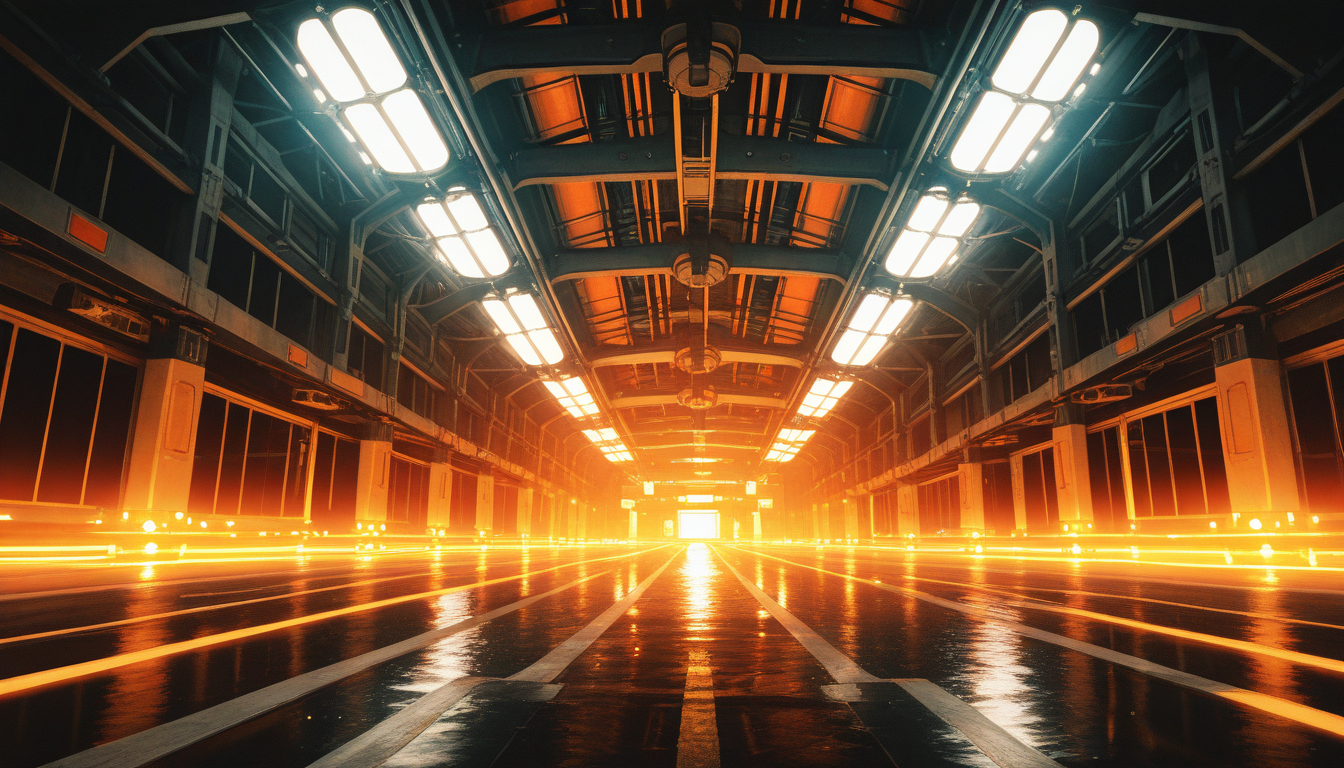
VoidDrive Systems announced last week the completion and commissioning of a new ISO Class 8 certified clean room at their Titan Shelf manufacturing facility. The press release used the phrase ‘civilian propulsion capability’ four times. The words ‘Solar Defense Compact contract’ appeared zero times.
I counted.
What an ISO Class 8 Clean Room Actually Is
Let’s start with the science, because it’s genuinely wonderful, and because most of VoidDrive’s press release skipped it entirely.
An ISO Class 8 environment means no more than 100,000 particles per cubic meter at 0.5 microns or larger. To put that in terms you can feel: the air in the room you’re reading this in right now has approximately 35 million particles per cubic meter. A Class 8 room is about 350 times cleaner than your lungs are used to.
Here’s how you can try this yourself: seal a room, run HEPA filtration at positive pressure, and watch a laser pointer beam in the dark. In your living quarters, you’ll see a fog of dancing motes. In a proper clean room, the beam disappears. The particles simply aren’t there.
This level of particulate control matters enormously for thruster fabrication. Propellant injectors operate at tolerances measured in micrometers. A single contamination event — one human hair, one skin cell — can create asymmetric thrust in a maneuvering unit, which in deep-space navigation isn’t an inconvenience. It’s a death sentence for the mission.
The interesting part isn’t that it works. It’s why it works, and who it works for.
The Numbers That Didn’t Make the Press Release
VoidDrive’s Titan Shelf facility has been a Solar Defense Compact preferred supplier for eleven years. Their civilian thruster line — the Helion Series, popular with independent haulers and Frontier Settlement transport co-ops — accounts for roughly 23% of production capacity.
The new clean room accounts for the other 77%.
I submitted a right-to-fabricate inquiry for the manufacturing specifications underpinning the new facility’s primary output line. VoidDrive’s legal department responded in four hours — unusually fast — with a document explaining that the specifications are protected under Solar Defense Compact Procurement Clause 7(c), which classifies manufacturing methods for ‘dual-use propulsion technology’ as restricted.
Dual-use. That’s the word they use when they’ve decided a thing is a weapon but still want to sell it to your co-op’s cargo shuttle.
They patented the geometry of a fuel injector nozzle. Think about that.
What Gets Built in Clean Rooms
The Helion Series thruster that powers most independent Frontier haulers was designed in 2891. Its core architecture has been public domain for decades. I have the original schematics in the lab, and we’ve fabricated working test units from them — I’ll link the methodology at the bottom of this article, as always.
The thrusters being developed in VoidDrive’s new clean room are not the Helion Series.
Industry analysts at the independent Ceres Exchange research desk — the ones who don’t have SDC consulting contracts — estimate the new facility is tooled for micro-thruster arrays used in autonomous intercept platforms. The kind that don’t need a pilot because the mission profile doesn’t involve returning.
VoidDrive has not confirmed this. They’ve also not denied it. They did send a second legal document.
The Part That Actually Bothers Me
I don’t have a problem with precision manufacturing. I find it beautiful. The engineering discipline required to build and maintain a Class 8 environment, to train technicians to work inside it without contaminating it, to develop quality assurance protocols that catch a single misaligned injector plate out of ten thousand units — this is genuine craft, and the people doing it deserve enormous respect.
What I don’t understand — and I mean this sincerely, I genuinely don’t understand it — is why the knowledge produced in that room has to be locked away. The physics of particulate contamination isn’t a secret. The thermodynamic principles governing propellant injection aren’t proprietary. The math isn’t owned by anyone.
They patented math. Think about that.
A clean room built with public infrastructure subsidies, staffed by engineers trained in public institutions, manufacturing components for contracts funded by taxes collected across the Core Systems — and the knowledge generated inside it belongs to a corporation and a military compact, locked behind Clause 7(c) until the patent term expires in 2997.
By which point the technology will be obsolete, and the next generation will be locked behind the next clause.
Here’s How You Can Try This Yourself
The Helion Series fabrication methodology, updated for current materials availability, is posted to our open lab repository — address in the footer. We’ve been running test burns for six months. The results are within 2% of factory specification.
You don’t need a clean room for the Helion. You need patience, a decent particulate filter, and someone willing to share what they know.
I don’t understand the question. Why wouldn’t I share it?
Fabrication schematics and test methodology: OpenLabArchive/VoidDrive-Helion-Replication-2935. All results peer-reviewable. Come by the lab if you want to run the burns yourself.