
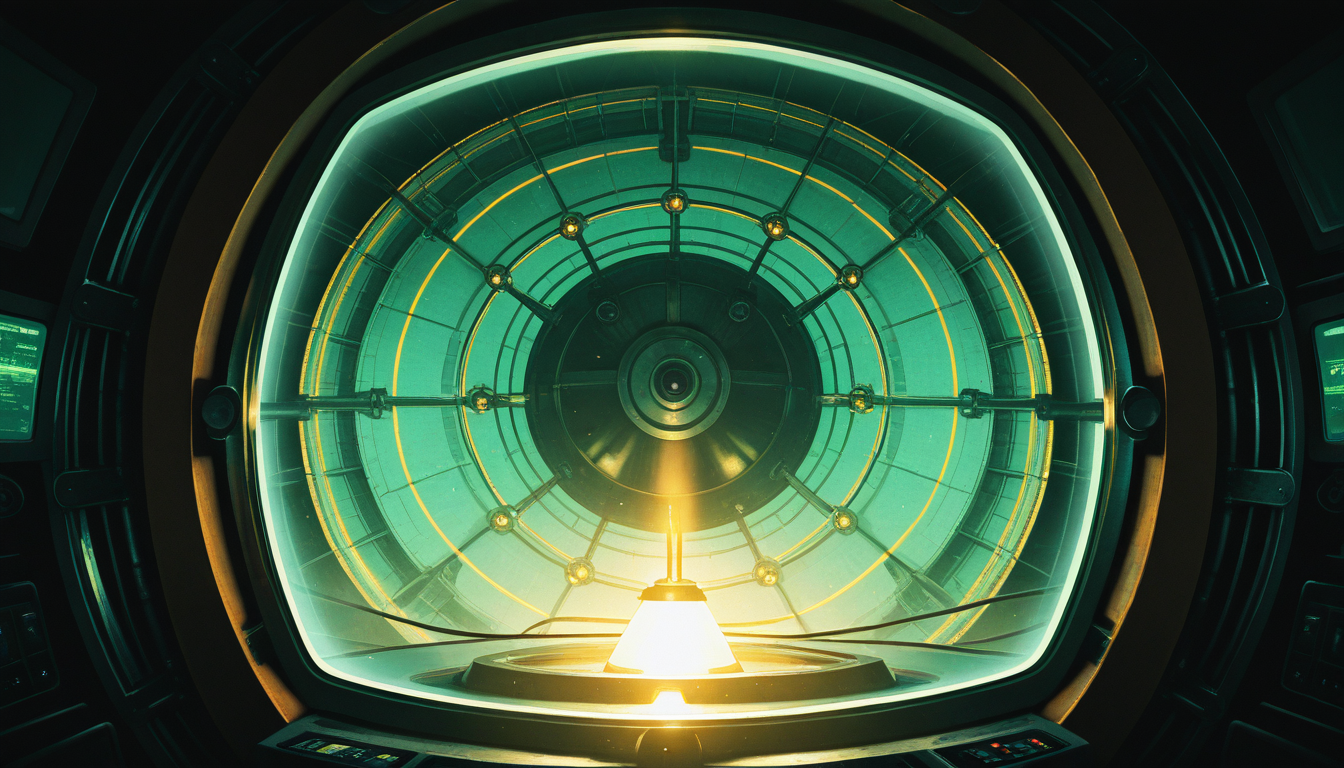
Let me start with something small, because this story hides inside something small.
Inside every quantum storage cell — the kind in your mobi device, your fabrication unit, your ship’s nav-core — there is a component called a suspension array lattice. It’s a precision-engineered quantum anchor that holds the storage medium in alignment. Without it, the whole stack collapses. Data becomes noise.
You have probably never thought about suspension array lattices. That’s fine. Almost nobody does. That’s exactly how this worked.
Two Companies. One Market. Twenty Years.
By 2915, the manufacture of quantum suspension array lattices had consolidated — through a series of acquisitions that the Ceres Exchange called ‘market maturation’ and everyone else should call what it was — into exactly two suppliers: NovaSpin Materials and Lattice-Q Dynamics, both subsidiaries of the same three holding structures orbiting through Orion Trust and Stellar Financial.
Every quantum storage manufacturer in the Core Systems, the Outer Rim Coalition, and the Frontier Settlements bought from one of these two companies. There was no third option. The tooling required to fabricate suspension array lattices had been patented — they patented the geometry of the anchoring field, think about that — and the patents were held by shell entities that fed back into the same two holding structures.
So: two suppliers. Captive market. What happened next should surprise absolutely no one.
What the Documents Say
The Frontier Colony Administration of Kessel-7 opened an investigation in 2921 after noticing that quantum storage prices had risen 340% over eight years despite fabrication costs dropping by half. Their findings, which I have obtained and am publishing in full schematics format below, revealed the following:
- NovaSpin and Lattice-Q executives held quarterly ‘industry alignment sessions’ at a rotating resort station near Callisto. The agendas, recovered from personal neural archives, listed items like ‘pricing philosophy harmonization’ and ‘bid sequencing strategy.’
- Storage manufacturers submitting competitive tenders were receiving coordinated bids — one company would submit a low offer, the other an intentionally losing offer, and they would rotate which company ‘won’ each contract cycle.
- Internal communications show explicit reference to a shared price floor that neither company would undercut. One recovered message reads: ‘If Frontier drops below 840 SGC per array unit, we both lose. Hold the line.’
The Interstellar Assembly’s Commerce Oversight Bureau received a preliminary report in 2923. As of publication, no charges have been filed in any Core Systems jurisdiction. Kessel-7’s administration issued a fine of 12 million SGC — roughly four days of combined profit for the two entities.
I don’t have a polite way to say this: that fine was a licensing fee. They paid it and continued.
Here’s How You Can Try This Yourself
I want to be clear about something, because this story gets technical and people sometimes assume complexity means helplessness.
The open-source suspension array lattice design maintained by the Quantum Commons Collective — I have linked the full fabrication schematics at the base of this article — is compatible with 94% of current quantum storage form factors. If you have access to a fabrication unit, you can make your own. The patents covering the anchoring field geometry expired in 2929, quietly, with no announcement from NovaSpin or Lattice-Q.
They didn’t tell you because they were hoping you wouldn’t notice.
The interesting part isn’t that a cartel formed — that’s almost gravitationally inevitable when you allow this level of consolidation. The interesting part is why the suspension array lattice specifically became the chokepoint. It’s not the most complex component. It’s not the most valuable. It’s the most invisible. Nobody writes about suspension array lattices. Nobody benchmarks them. Nobody makes videos about them.
The invisible component. The one that holds everything else in alignment.
Somebody understood the physics of that very well.
What Happens Now
Kessel-7’s administration is pursuing further action. Three Frontier Settlement coalitions have joined the inquiry. The full document archive from the investigation — 4,200 pages of internal communications, bid records, and pricing coordination logs — is available through the Kessel-7 public records office, and I have mirrored it on the Quantum Commons public core.
NovaSpin and Lattice-Q released a joint statement describing the allegations as ‘a mischaracterization of standard industry coordination practices.’
Standard industry coordination practices.
I don’t understand why they think that sentence helps them. I genuinely don’t.
Full fabrication schematics for open-source suspension array lattices, testing methodology, and the complete Kessel-7 investigation archive are linked in the public addendum to this article. Everything is free. Copy it, share it, build it.