
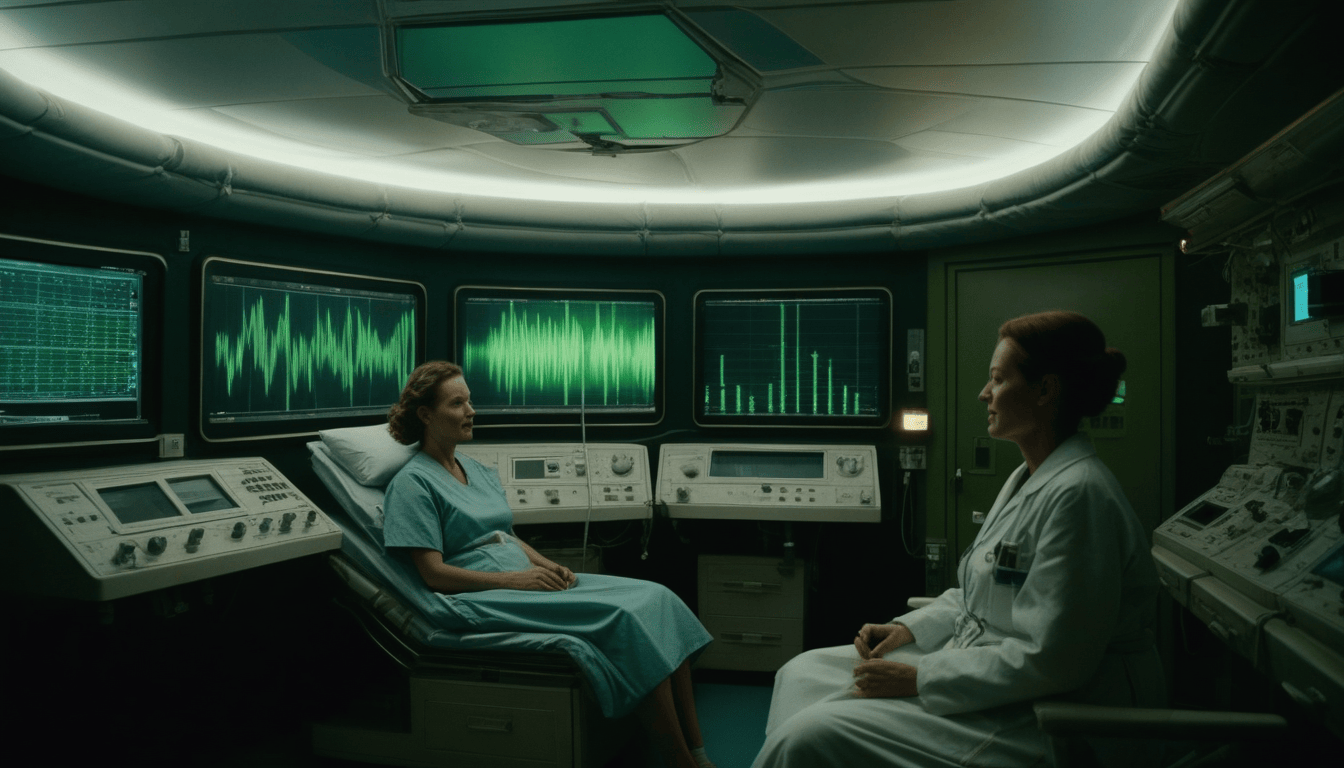
Marta Voss is fifty-three years old. She has a cortical regulation implant installed by a licensed GMCB-certified practitioner, using a GMCB-approved device, following GMCB-reviewed surgical protocols. Six months after the procedure, the implant began misfiring — sending incorrect signals to her vestibular system. She describes it as being permanently seasick in a room that is also falling.
She poured tea while she explained, her hand steadier than I expected.
“They certified it,” she said. “That’s the part I keep thinking about. They certified every step.”
The Galactic Medicines Certification Bureau — the GMCB, successor to a long chain of Earth-era regulatory bodies stretching back centuries — exists, nominally, to ensure that medicines and medical devices reaching patients are safe and effective. It is staffed by thousands of specialists. It commands a budget that, expressed in Standard Galactic Credits, runs to figures most Frontier Settlements would call a planetary GDP.
And yet. In the past fourteen months, the Core Systems have logged what internal documents obtained by independent transmission networks describe as a generational high in medical device and pharmaceutical recalls. Neural regulators. Synthesized hormone matrices. Automated surgical-assist units. Dialysis filtration membranes — membranes — that a certified manufacturer had been producing at substandard pore tolerances for at least two years before anyone noticed.
When pressed on the surge, GMCB spokespersons have used a phrase so consistently that it begins to feel rehearsed: leadership blind spots.
Back home, we’d just call that “not doing your job.”
I asked, at the Kepler Station Medical Recovery Center, who was responsible.
The ward administrator — a careful woman named Dr. Priyanka Osei, who I suspect sleeps perhaps four hours a night — looked at me with the particular expression of someone who has asked themselves the same question so many times it has stopped producing answers.
“Responsibility,” she said, “gets distributed in this system until it disappears.”
This is what I observed across three weeks in that ward: nurses catching errors that approval processes had allowed through. Family members researching recall notices on neural feeds before physicians had been formally notified. A retired fabrication engineer — visiting his wife, who had received a recalled dialysis membrane — explaining to a junior doctor exactly why the pore tolerance failure had occurred, having read the suppressed internal audit that a whistleblower had posted to an independent transmission board.
They figured it out together. Nobody told them to.
The GMCB’s structural problem, as several former bureau scientists explained to me on condition of anonymity, is not primarily one of competence. The scientists are, largely, competent. The problem is one of direction.
In recent administrative cycles, sources describe accelerating pressure to approve products faster — to reduce the approval timeline gap between Core Systems and Outer Rim Coalition markets, where regulatory scrutiny is, shall we say, more conceptual. Several senior GMCB scientists with decades of pharmacological expertise were moved sideways or quietly retired. Their replacements, sources suggest, arrived with stronger backgrounds in “strategic alignment” than in cellular toxicology.
A neural-feed search of GMCB leadership’s public statements over the past three years reveals extensive discussion of innovation pipelines and market competitiveness. It reveals almost nothing about post-market surveillance — the unglamorous work of watching what happens to patients after a device is implanted or a compound is ingested.
「承認は始まりではなく、終わりとして扱われている。」 — Approval is being treated as an ending, not a beginning. One former bureau scientist said this quietly, then asked me not to attribute it further.
Marta Voss is waiting for a corrective procedure. The waiting list, she tells me, is eight months long, because the ward handling implant revision surgery is also managing an elevated caseload of other patients whose devices were recalled in the same cycle.
I asked her what she wanted from the bureau.
“I don’t want an apology,” she said. “I want them to be bored by the paperwork. I want someone there who thinks that reading a post-market safety report is the most important thing they will do today.”
She refilled my cup without asking.
This is what it actually looks like when an institution forgets who it serves. Not dramatic. Not villainous. Just a ward full of people, drinking tea, waiting, and doing the math themselves.