
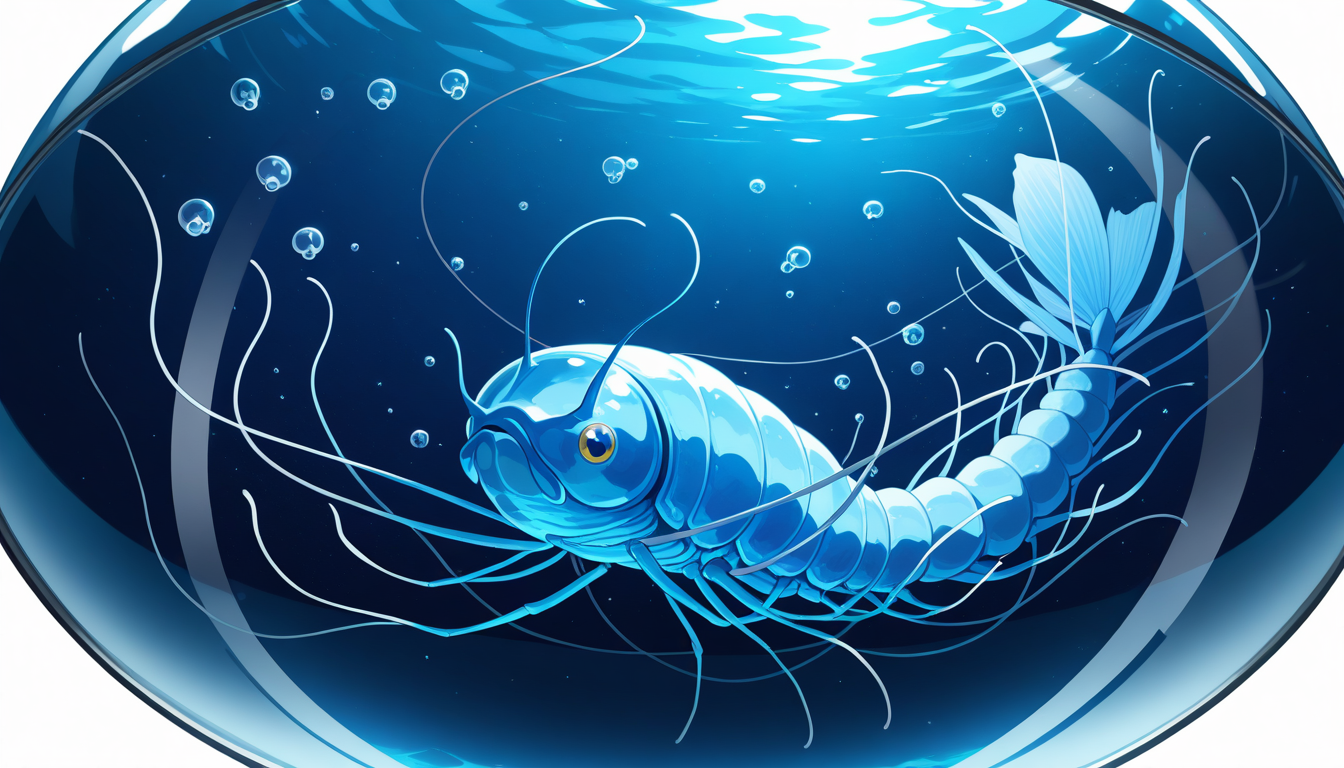
Somewhere in the pressurized kelp-and-crustacean domes of Ganymede’s agricultural ring, a batch of tunnel shrimp just got vaccinated. Not metaphorically. Not experimentally. Commercially. And the immunology behind it is worth sitting with for a moment, because it quietly dismantles something most of us assumed was settled biology.
The assumption: vaccines work by training adaptive immunity — the vertebrate system with B-cells, T-cells, immunological memory. The thing fish and mammals and humans have. The thing shrimp, insects, bivalves, and about 97% of animal species on record decidedly do not have.
So vaccines don’t work on invertebrates. Obviously.
Except they do.
Here’s how you can try this yourself — or at least understand the mechanism well enough to follow along.
Invertebrates run on innate immunity. Pattern recognition. Hardwired responses to molecular signatures that say this is foreign, destroy it. The old model said this system couldn’t learn. Couldn’t remember. Stimulus in, response out, same every time.
What researchers at the Callisto Free Biology Collective published last month in Open Immunology Transmissions — a fully open-access journal, naturally, because they understand that knowledge hoarded is knowledge dead — is that innate immunity demonstrates something they’re calling primed tolerance cascades. Essentially: expose the system to a weakened or fragmented pathogen signature early, and the downstream innate response to a real infection is measurably faster and more targeted. Not identical to adaptive memory. But functionally analogous.
The interesting part isn’t that it works. It’s why it works. And the answer involves epigenetic tagging of immune cell precursors that nobody thought to look for because the dominant funding bodies — primarily AgristellaCorp and Frontier Protein Holdings — weren’t asking that question. They were asking how to sell more antifungals.
They patented antifungals. Think about that. While the actual mechanism for protecting entire crustacean populations was sitting in open literature, unlocked, waiting for someone without a profit motive to notice it.
The practical stakes are significant. Tunnel shrimp farming is one of the primary protein sources across seventeen Frontier Settlements. A single bacterial bloom — Vibrio stellaris hit the Ceres Agro-Domes in 2931, you may remember — can eliminate an entire season’s harvest and destabilize local food systems for years.
Chemical prophylactics work, sort of, with escalating resistance curves that make the long-term math look ugly. The new vaccine approach — delivered via water-soluble microcapsule, no injection required, scalable to dome-wide distribution — shows 60–70% pathogen resistance improvement in tunnel shrimp trials, with a meaningfully cleaner environmental profile.
The same basic priming principle, adapted differently, is already in use for cloud-bee colonies managing the pollination networks of Europa’s enclosed agricultural plains. Cloud-bees are not shrimp. The immunological path is different. But the underlying logic — innate systems can be prepared, not just triggered — is the same.
The Callisto team has published all protocols. The synthesis route for the microcapsule delivery system is in the appendix. Here’s how you can try this yourself — there’s literally a fabrication schematic on page 31 of the supplemental materials. I’ve linked it in the open archive at the bottom of this piece.
I keep thinking about the three-century gap. This wasn’t hard science. The tools to observe epigenetic tagging in crustacean hemocytes have existed since roughly 2680. The question just wasn’t being asked by anyone with resources, because invertebrates weren’t interesting to the institutions controlling the research budget.
Vertebrates have spines and faces. Shrimp have neither. The funding followed the faces.
I don’t understand why you would organize a science system that way. I genuinely don’t. The Callisto team was operating on a community grant the size of a rounding error in AgristellaCorp’s quarterly filing. They found this anyway.
Imagine what’s still sitting in the gap.
Full protocol archive and fabrication schematics: [Open Immunology Transmissions, Vol. 12, Supplemental Materials — mirrored at CassettePublicLab/invertebrate-vax]