
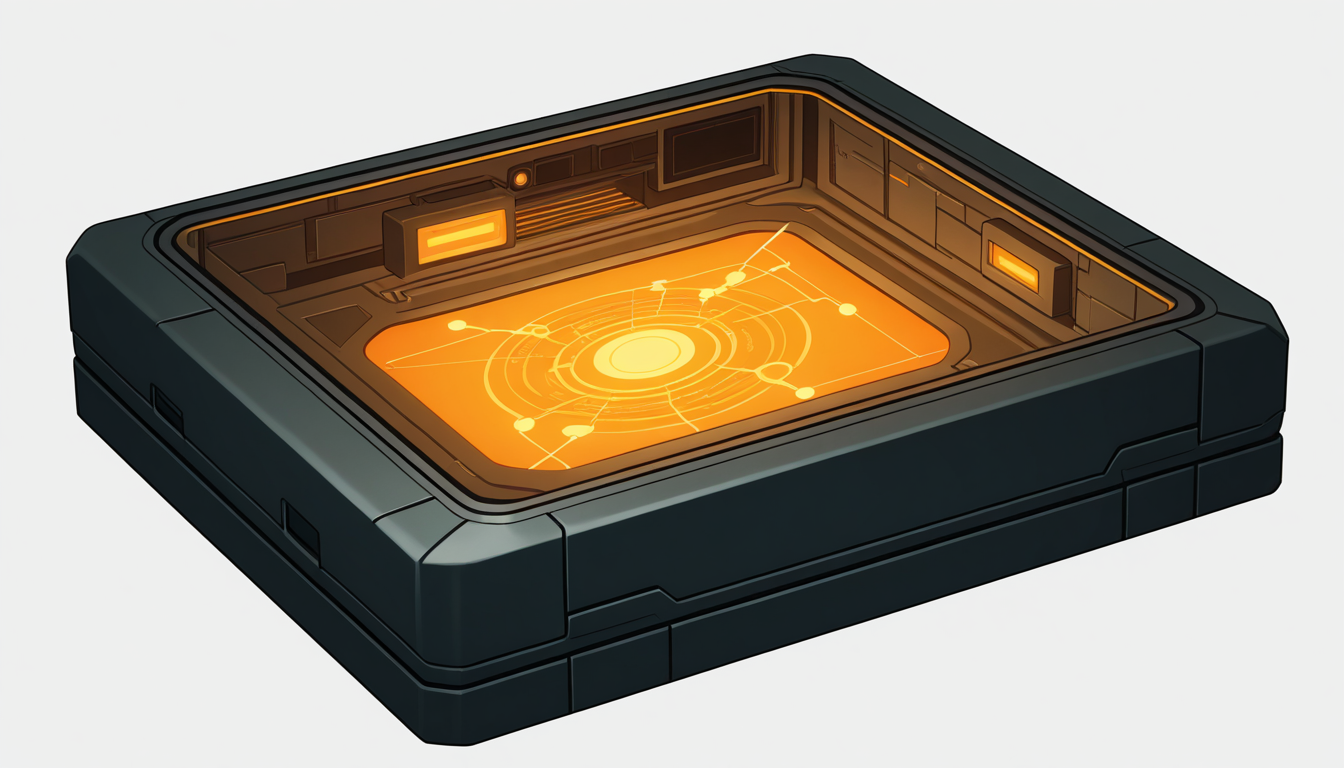
The Chamber Revolution: What This Habitat Shell’s Airflow Engineering Is Actually Teaching Us
The first time I saw the VoidForm EX5 at the Kepler Fabrication Expo, I thought someone had made a mistake. There’s a wall inside the shell that doesn’t go all the way to the top. On purpose.
Here’s what that actually means.
Most habitat shells — the enclosures that house your processing cores, thermal units, quantum storage arrays, everything — move air the same way they did six hundred years ago. Intake at the front, exhaust at the back, hope for the best. The EX5 and EX6 do something different. They divide the internal volume into discrete pressure chambers, each operating at a slightly different atmospheric gradient. Hot air doesn’t wander. It goes where physics tells it to go, because the geometry makes physics cooperative instead of fighting it.
The interesting part isn’t that it works. It’s why it works.
I spent two hours with VoidForm’s CTO, Ren Okafor, and their lead thermal engineer, a quietly intense person named Solis who kept correcting my terminology in the most patient way possible. They were generous with details. Unusually so, actually — they handed me the pressure-differential schematics before I even asked. I’ve included them at the bottom of this article, fully annotated, because that’s how this should work.
The Problem With “Good Enough”
Okafor explained that standard shell designs hit a thermal ceiling around 340 watts of continuous processing load before airflow becomes turbulent enough to cause hot-spot pooling. The EX5’s chamber design pushes that ceiling to somewhere between 480 and 510 watts in their controlled testing, depending on component layout.
The mechanism is elegant and almost embarrassingly simple once you see it: the partial dividing wall creates a low-pressure zone at the rear upper chamber that pulls hot air up and away from your processing cores before convection has time to spread it horizontally. You’re not moving air faster. You’re making gravity and pressure do the work for you.
“We kept asking ourselves why nobody had tried this before,” Solis told me, sketching a quick diagram on a napkin I’ve also scanned and included below. “The answer, honestly, is manufacturing cost. The tooling for that internal wall adds about 18 to 22 SGC per unit at our production volumes. Most shell manufacturers decided that wasn’t justifiable.”
That’s the decision I want you to sit with for a moment. Eighteen credits. The difference between a thermal ceiling that causes processing throttle under sustained load and one that doesn’t. Set aside because eighteen credits felt too expensive.
Here’s how you can try this yourself: if you have a standard shell and basic fabrication access, a partial dividing baffle positioned at roughly 65% of internal depth, terminating about 40mm below the top exhaust plane, will approximate the EX5’s pressure differential with materials that cost almost nothing. Schematics are at the end of this piece.
What the Manufacturing Discussion Actually Revealed
The most interesting part of my conversation with Okafor wasn’t the thermal data. It was when he explained how they had to justify the EX5’s design internally.
The chamber wall required a new stamping die. New tooling means upfront capital, which means a conversation with people who care about amortization schedules and not fluid dynamics. The thermal engineering team had to build a cost-recovery model showing exactly how many units they needed to sell before the die paid for itself.
“We almost didn’t make it,” Okafor said, in the tone of someone who has made peace with something that could have gone differently.
I find this genuinely strange every time I encounter it — not naively, I understand why the economics work this way, I just find it spiritually exhausting. The knowledge of how to build a better thing existed. The materials existed. The constraint was a spreadsheet.
That said: VoidForm made the call, the tooling exists, and now we have the schematics. So here we are.
Build Notes
The EX5 is the smaller form factor; the EX6 adds approximately 40mm of vertical depth and supports a second independent pressure chamber for extreme-density builds. Both ship without fans — VoidForm’s position is that fan selection is too personal to mandate, which I respect enormously.
Cable routing channels are deep and thoughtfully placed. The side access panels require no tools. The internal surface finish is non-reflective matte, which matters more than you’d think for thermal imaging diagnostics.
Full tested schematics, pressure-differential diagrams, and the DIY baffle fabrication guide are attached below under open license. Take them. Build with them. Tell me what you find.
— Testing methodology and raw data available at the public lab node: voidform-ex5-thermal.openlab.mesh