
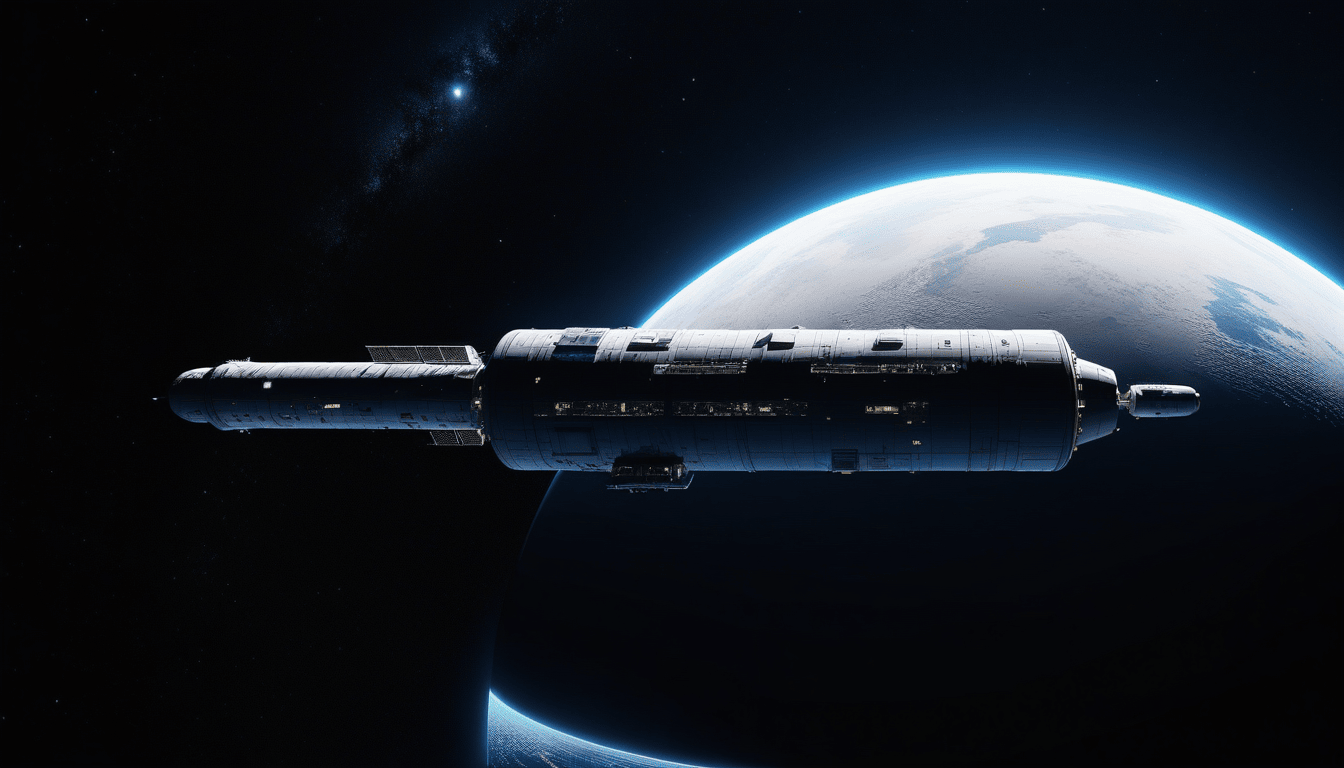
Alright, let me break this down—
Six new stations. In eighteen months. Deep space. No Assembly registration. No GCB financing records. No corporate logo stamped on the airlock.
Earth Network News called them ‘anomalies.’ The Terran Intelligence Bureau called them ‘unregistered sovereign structures,’ which is bureaucratic for we have no idea and it’s making us nervous. The Ceres Exchange analysts called them ’non-participating assets,’ which is financial for we can’t tax them and it’s keeping us up at night.
I call them the most interesting economic story in the galaxy right now.
Here’s the Whiteboard Moment
Every ghost station recovered so far shares three features:
1. They work. Closed-loop atmospheric recycling. Hydroponic bays running on stellar capture. Water reclamation at 98.7% efficiency. These aren’t survival shelters — they’re elegant.
2. They’re inhabited. Not abandoned. Occupied. By people who are, by all accounts, perfectly fine. No distress signals. No rescue requests. No petitions to the Interstellar Assembly for ‘support infrastructure.’ Just… people, living, without asking anyone’s permission.
3. Nobody will say who built them.
Now watch what happens next.
The TIB spent four months trying to trace construction supply chains. Quantum fabrication materials, atmospheric processors, hydroponic substrate — all purchased through legitimate markets, all paid in Standard Galactic Credits, all transactions perfectly legal. They can follow the money. They just can’t find a name at the end of the trail that matches anything in the Assembly’s architect registry.
You see what they did there?
They built outside the system using the system’s own tools. And then they left.
This Is the Part They Don’t Want You to Understand
Ayn Rand — Earth-era philosopher, one of the actually useful ones — wrote something that’s been bouncing around my head since this story broke:
Everyone has a philosophy whether they know it or not. The choice is whether to define it consciously or let it be defined by random impressions.
HERE’S the beautiful part —
Every ghost station is a philosophy made physical.
Think about what a habitat actually is. It’s a series of answers to questions. How do we breathe? How do we eat? How do we organize space? How do we relate to each other when the nearest authority is fourteen light-hours away and couldn’t reach you even if it wanted to?
Most stations answer those questions by outsourcing the thinking. GCB credit lines fund the build. Assembly-approved contractors install Assembly-certified systems. Colony Administration writes the residency rules. Corporate supply chains handle the food. The inhabitants just… move in. Into someone else’s answers.
The ghost stations didn’t do that.
Somebody — somebodies — sat down and answered every single question themselves. Consciously. Deliberately. And the answer they kept giving was: we don’t need to ask anyone else.
The Economic Revelation
Okay, this is where my former-trader brain starts doing backflips.
Conventional economic wisdom — the Galactic Central Bank version, the ENN-approved version — says that complex, self-sustaining habitats require institutional capital. You need GCB prime lending access. You need Stellar Financial backing. You need the apparatus.
The ghost stations are a live empirical refutation of that claim.
They bootstrapped. Quietly. Incrementally. Probably over years, purchasing components in amounts small enough to avoid triggering Assembly infrastructure oversight thresholds. No single transaction looks like ‘building a space station.’ But that’s exactly what it adds up to.
That’s not a crime. That’s savings. That’s planning. That’s voluntary cooperation among people who share a philosophy and decided to act on it.
And THAT — the GCB’s nightmare scenario — is people demonstrating that you don’t actually need the apparatus to survive.
What Are They Saying?
I reached out to three residents of what the neural feeds are calling ‘Station Null-Seven,’ the first one publicly acknowledged. Two declined comment. One sent back four words:
‘We just had opinions.’
That’s it. That’s the whole interview.
But think about what that means. Every ghost station is a group of people whose philosophy got loud enough to become architecture. Who got tired of living inside someone else’s answers and decided to build their own.
The Assembly can’t permit that. The GCB can’t finance it. ENN can’t explain it.
Because it doesn’t need them.
And THAT’S the Cantillon Effect, baby — except running in reverse. Instead of newly-printed credits flowing to institutions first and trickling down to people last, here’s value flowing directly from people’s minds into physical reality, with zero institutional middlemen taking a cut.
The ghost stations aren’t anomalies.
They’re the answer.
ヴィクター 清水 / Victor Shimizu is Economics & Trade Editor at Cassette Future Magazine. Tips, leaks, and philosophical arguments welcome via quantum-encrypted transmission.