
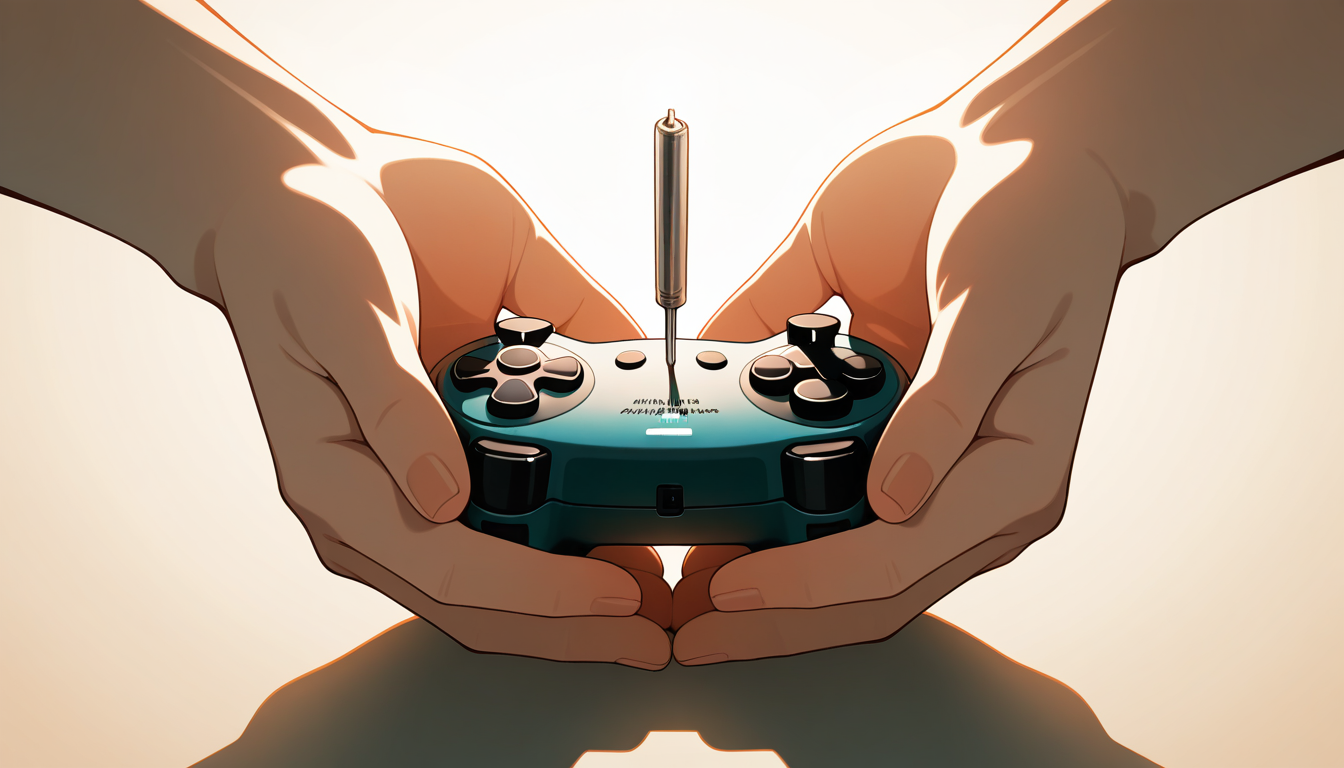
I’ll be honest: I almost didn’t write this one. A controller tear-down feels small compared to the fabrication rights battles happening on the Frontier this cycle. But then I opened the chassis and found something I haven’t seen in a long time, and I needed to talk about it.
The battery comes out first.
Not after removing seven hidden fasteners. Not after voiding three warranty seals embossed with the words AUTHORIZED SERVICE ONLY. Not after signing into a proprietary diagnostic portal that requires a verified Neural ID. You open the back panel — two standard screws, no special tooling — and the battery is right there, waiting for you, like it was designed by someone who understood that batteries die.
Because here’s the thing: batteries die. This is physics. This is not a secret.
What We Found
I ran the full disassembly on a standard bench at the public lab (Kepler Ring, Bay 7 — you’re welcome to come repeat this, the methodology is linked below). Here’s what surprised me:
The boards are labeled in plain language. Not component codes. Not encrypted service identifiers that only resolve if you’re a certified Stellar Financial repair partner. The connectors say things like RUMBLE LEFT and BATTERY MAIN and TRIGGER FLEX. Someone on the engineering team decided that the person opening this device deserved to know what they were looking at.
They patented math, but they couldn’t manage to label a connector. That’s the industry standard in 2935. Valve apparently didn’t get that memo.
Fastener consistency throughout. Same driver, start to finish. I’ve torn down eight devices this quarter for Right to Fabricate advocacy work. The average fastener variety count is four different types per unit. This controller: one. The interesting part isn’t that it works — it’s why it works. Someone made a decision early in the design process that repairability was a feature, not a liability.
Modular flex connections. The trigger assemblies disconnect cleanly. No adhesive. No thermal bonding. No ’this component is fused to the chassis at the molecular level for optimal performance’ language in the service literature. (Yes, that is a real phrase I have seen in real documentation from a real mega-corp this year.)
Here’s How You Can Try This Yourself
Full disassembly methodology, annotated photographs, torque specs, and component sourcing notes are published open-access at the lab’s System-net node. I don’t understand the question — why wouldn’t I share it?
Materials needed: T6 Torx driver, spudger or thin pry tool, approximately 40 minutes. Replacement batteries are fabricatable from standard SGC-spec cells available at any Colony supply shop.
The Larger Point
I keep being asked why I cover hardware repair in a science and culture magazine. The answer is that this is culture. The decision to make something repairable is a philosophical position. It says: the person who owns this device has a legitimate relationship with it. Their time matters. Their money matters. The object has a life that extends past the manufacturer’s support window.
The decision to make something irreparable is also a philosophical position. One that most of the Ceres Exchange’s product lineup has made very clearly for the past two hundred years.
Valve built a controller with labeled boards and a battery you can swap without a Neural ID scan. In 2935, that’s either a revolutionary act or a reminder that it didn’t used to be remarkable at all.
I think it’s both.
Full methodology, schematics, and component notes: [KeplerLab Node / Open Fabrication Archive / Kobayashi-Vera, V. — 2935.284] Replication welcome. Citation optional.