
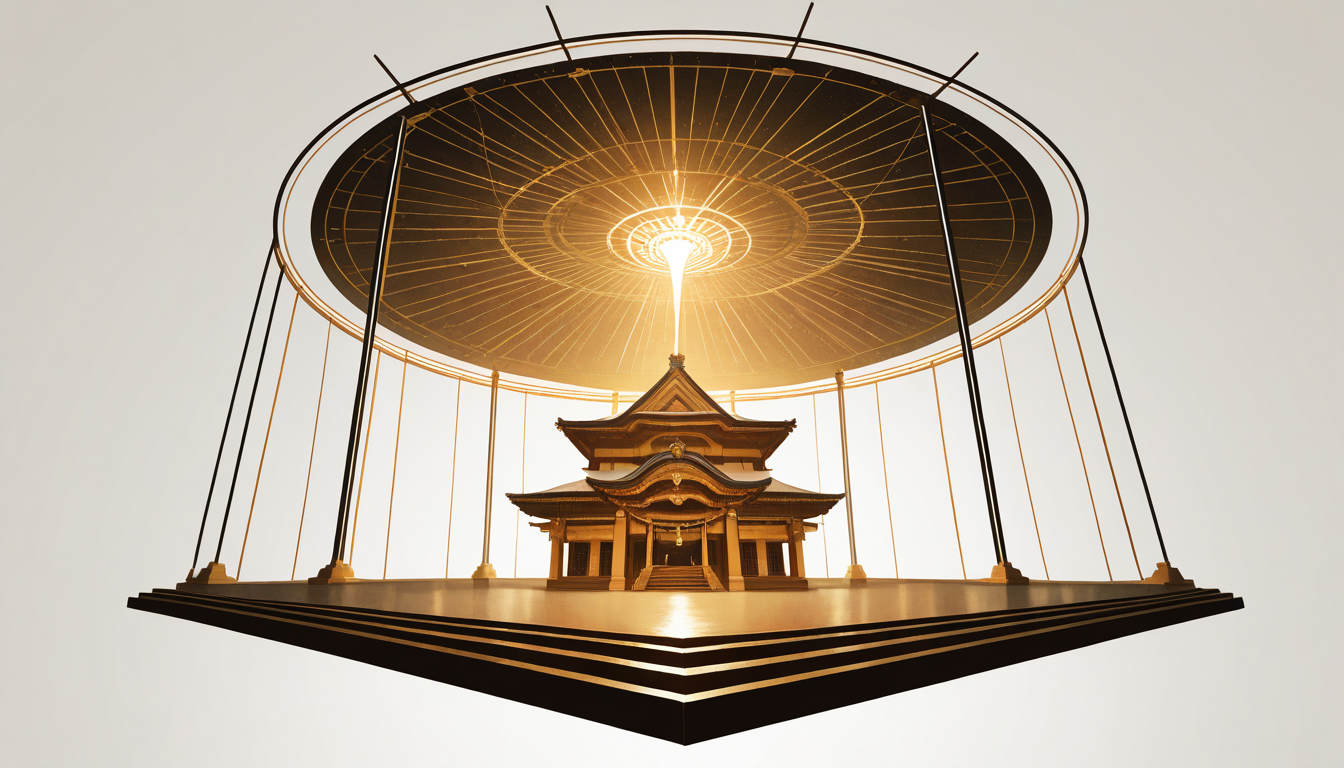
I want to talk about a city as a story. Specifically: Arcadia Prime — the ecumenopolis-class capital station at the nexus of the Kepler Corridors, where seventeen major transit lanes converge and the Interstellar Assembly holds court above two hundred stacked decks of everything else.
Architects call it an engineering miracle. Urban historians call it a growth model. I’ve been reading it as a moral argument, and I’m troubled by what it’s actually saying.
But what is it actually saying?
The surface story is about infrastructure. The real story is about — who is permitted to be visible.
Arcadia Prime didn’t become a layered megacity by design. It became one by accumulation and avoidance. The station sat at the confluence of the Kepler Corridors before it was a capital. It was already dense, already contested. When the Interstellar Assembly designated it the administrative heart of the Core Systems, something predictable happened: the Assembly District became protected ground plane. Untouchable. Preserved.
And so growth had nowhere to go but down.
Urban ecologists call this the 閾値崩壊 — the threshold collapse. You build horizontally until you hit a physical or political ceiling. Then you don’t just build taller. You build entire new floors. You create decks. You create a city underneath the city. And then, because those decks fill up and need infrastructure and the upper levels need buffer zones, you build decks under those decks.
The light diminishes by forty percent for every twelve decks descended. Everyone knows this. The Assembly District gets full-spectrum solar simulation. Deck Eighty-Seven, last I visited, smells like recycled atmosphere and someone else’s exhaust.
Look at what the ending asks us to accept: that this is simply how cities grow. That the stratification is incidental. That there was no decision made, just a series of logistical necessities.
But a city is not a geological formation. It is a record of choices.
The Assembly District was protected because it was symbolically important. The protection of symbolic importance required vertical displacement of everything else. The displacement was never announced as a policy. It emerged from the accumulated weight of a thousand smaller decisions — zoning designations, transit routing, fabrication permits, load-bearing regulations — each one local, each one reasonable, each one quietly encoding the same hierarchy.
This is a story about what it means to build a civilization and call its shadow an accident.
The villain of this particular narrative — and every city has a villain, usually called ’the planning process’ — believes that the people who live on Deck Forty through Deck One-Ninety-Three simply chose to live below. The market placed them there. Demand and supply. The villain believes this, and the city’s architecture agrees more than its administrators will admit. Every load-bearing column on Deck One is, structurally speaking, resting on everyone beneath it.
I keep returning to a small detail from the urban historian Yara Osei-Mensah’s recent monograph Floors Without Ceilings — that the original Arcadia Prime settlement records show no vertical planning at all. The first builders built outward, not downward. The layering began precisely when the Assembly District was designated protected.
Protection at the top. Compression below. Layers as consequence.
The surface story is about hyperlane economics and architectural necessity. The real story is about — how power maintains its altitude by making altitude itself structural.
Arcadia Prime is a beautiful city. I’ve wept on Deck Three at the simulated sunrise. But I’ve also stood on Deck One-Forty and watched the ventilation fog roll through a corridor that hasn’t seen natural light in four hundred years, and thought: this city has an argument it never made out loud. It simply built it.
Some arguments are too dangerous to speak. So instead, you pour them in durasteel and call it urban planning.
彼女は、建物の中に哲学が埋め込まれていると信じている。
松田 ジェイドは Cassette Future Magazine の Books & Media 批評家であり、建築を未読の文学として扱うことで知られる。