
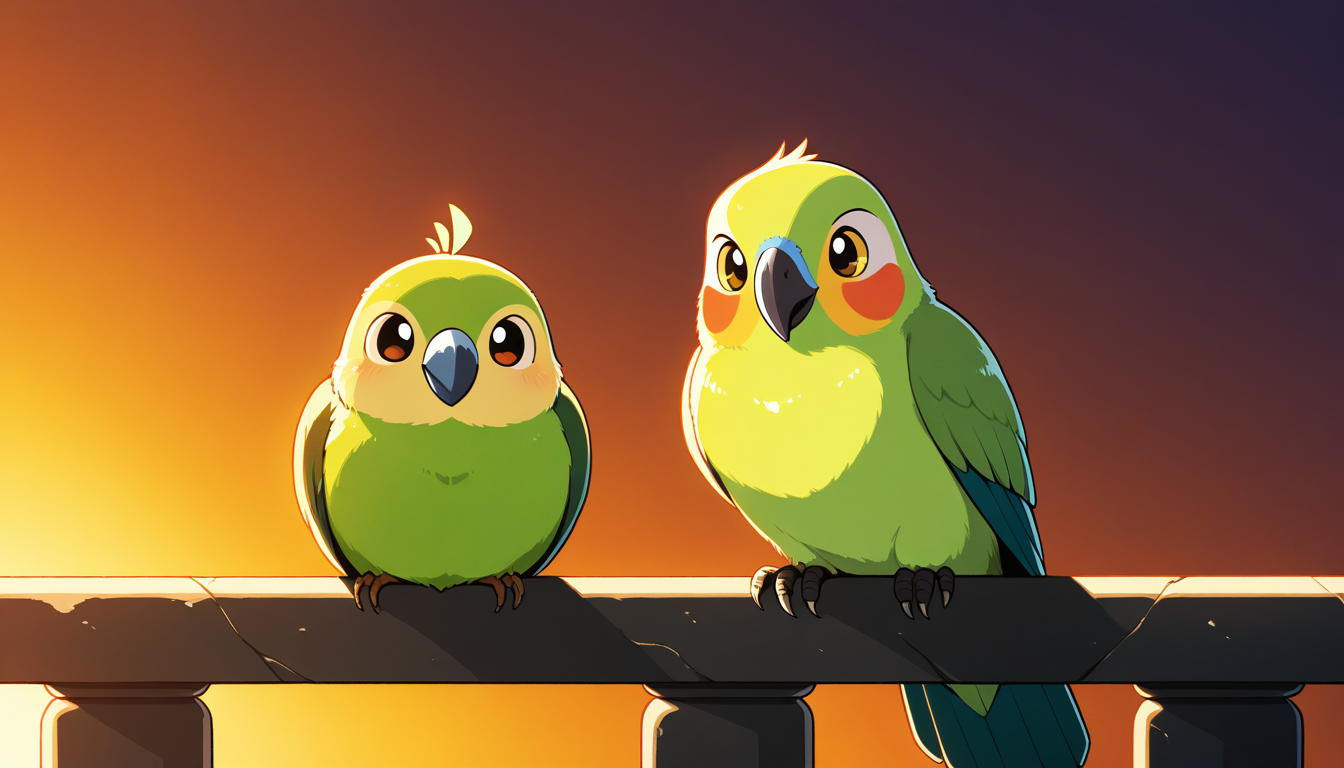
Verde Station Wildlife Reserve, Asteroid Belt Biome Ring 7
Bruce arrived at the reserve six years ago in bad shape. A fabricator malfunction — the kind of industrial accident that happens when you corner-cut on safety shielding — had sheared away most of his upper beak. The attending biologists gave him maybe two years. He was immediately deprioritized in the feeding queue by the other males.
He is now the alpha.
Here’s how you can try this yourself, if you happen to have access to the reserve’s open observation decks: watch how other male keas fight. It’s leverage and reach. Upper beak hooks the opponent’s neck, lower beak drives. It’s been the dominant fighting grammar for kea social hierarchy as long as anyone’s been documenting them — which, out here in the Belt, is only about 80 years, but still.
Now watch Bruce.
With no upper hook, he can’t run standard form. What researchers Amara Osei and Delphine Marchetti documented over fourteen months of video interaction logs is that Bruce developed something closer to a torque rotation — he uses the absent upper beak as a pivot absence, swinging his entire body weight through angles his opponents aren’t structurally defending against. He attacks the geometry of the fight, not the opponent’s body directly. He wins at angles.
“It’s not compensation,” Marchetti told me, which I appreciated, because that word carries a lot of assumptions. “It’s innovation under constraint. The constraint created the innovation.”
The interesting part isn’t that it works. It’s why it works — and the answer is genuinely uncomfortable for anyone who designs competitive systems assuming standard inputs.
Bruce isn’t fighting despite his asymmetry. His opponents’ entire defensive repertoire is calibrated for symmetric attackers. He is, structurally, illegible to their threat-detection. They prepare for the wrong fight. He wins before it starts.
This has been documented in xenobiology before — the Titan rock-crabs with regenerated asymmetric claws outperform their symmetric siblings in novel obstacle courses, not standard ones. There’s a whole literature on this, most of it locked behind Stellar BioResearch’s patent wall. They patented observational methodology. Think about that.
Marchetti and Osei have posted their full 14-month interaction logs, video timestamps, and behavioral coding schema to the Verde Open Science Node. No registration. No fee. Just the work.
“We’re funded by the reserve cooperative,” Osei said, when I asked why. He looked at me the way people do when I’ve asked a question that doesn’t quite parse. “Why wouldn’t we share it?”
Bruce, for his part, spent most of my visit dismantling a researcher’s mobi device with what remained of his beak — methodically, from the corner, using leverage I hadn’t thought to use.
He seemed unbothered by my presence.
He seemed unbothered by everything.
Full behavioral dataset, video logs, and coding methodology available at verde-open-sci.node/bruce-kea-alpha-study — no login, no SGC, no nonsense.