Gunkhana Devlog 10: The Game Is a Tape
For most of its life this game was called “gunfight”, which is also the name of the mode it borrows from someone else’s game. I floated Gunkhana, from gymkhana, and worried it was too niche. The agent argued for keeping it: it fits a game about stunts and movement, and “khana” means house, so it reads as gun house. The risk is people reading it as “gunk.” We kept it anyway.
The Deck
The first interface pass was tasteful gunmetal. I said: “You can push it further. Cassette Futurism is the aesthetic we are going for,” and sent pictures of cassette J-cards and VHS sleeves. Flat colour, stripe bands, huge numerals.
The current design is called The Deck. The game is a tape, the menus are its J-card, and a match is a recording. The five-colour stripe is a legend that means the same thing on every screen: red is danger to you, mustard is reward, cream is print, teal is live values, deep teal is locked. Finished matches go on a shelf as tapes.
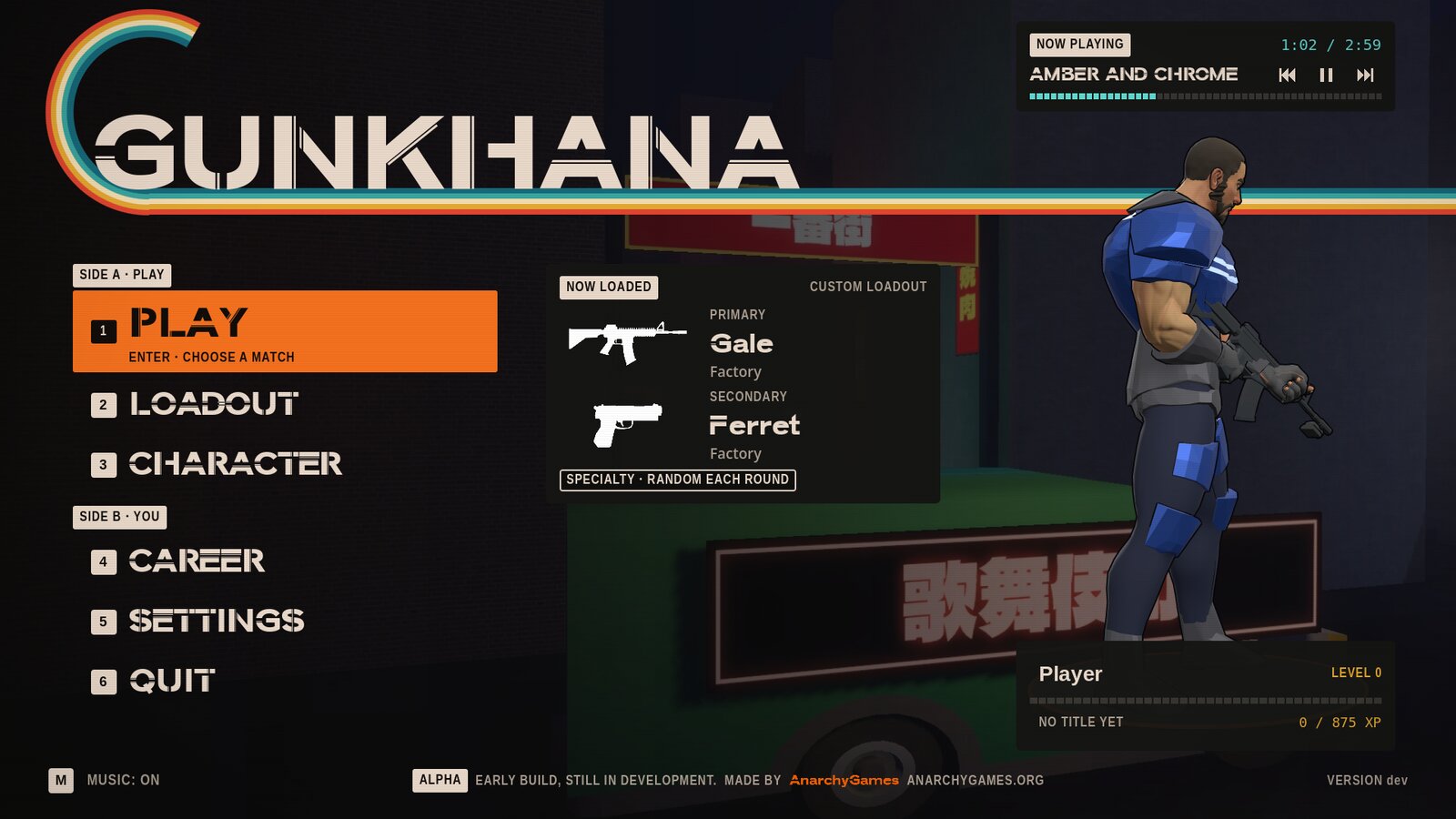
Also new lately: traps (proximity mines, teleporter pads, laser mines, an EMP, a tether that yanks you back; I played the placeholder version and my review was “I love it lol”), team colours picked by the captain, a ranked mode, and a soundtrack that is now four of my own songs.
Things the robot broke
In the interest of honesty, a partial list:
- My entire desktop. A texture script multiplied two arrays the wrong way, reached 56 GB of RAM, and the system killed everything, including the agent. My message when it came back: “You crashed! it said device memory full.”
- My credits. Six agents working in parallel burned through the usage allowance in 33 minutes. All six died mid-task with nothing committed. It had just told me the job would take about three hours. I asked, “are you sure?”
- My settings. Automated tests kept overwriting my real settings file.
- My sound. See devlog 03.
- Itself. Twice in one session it ran a command to kill a stuck process that also matched its own shell. It killed itself. Twice.
- A character rig. After several rounds of hand-built rigging on one model, my review was that it “cannot go in the game.” Rigging goes to proper tools now.
Each of these became a written rule the agent reads at the start of every session. That is the real workflow: I play, I complain in plain words, the complaint becomes a measurement, the measurement becomes a fix, and the mistake becomes a rule.
Where it stands
About 1,900 automated tests. Over a thousand commits. 36 characters, 16 maps, 2v2 and 5v5. By my own estimate the game is about 60% done, which in game development means the remaining 40% will take the other 90% of the time.
More soon.